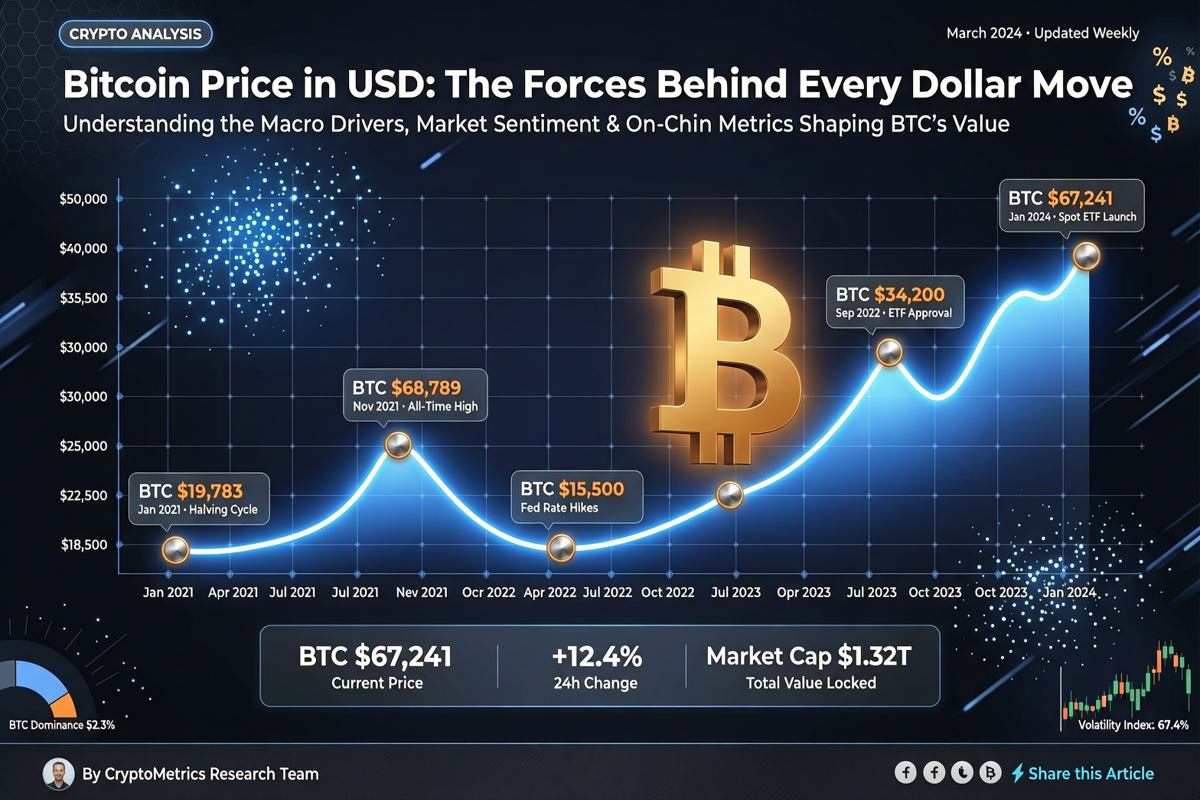
Bitcoin Price in USD: The Forces Behind Every Dollar Move
Bitcoin's price in U.S. dollars swings on supply, macro trends, and sentiment. Discover what really moves the BTC/USD pair in 2025 and how to read the signals.
Why the Bitcoin-Price-in-USD Ticker Never Gets Old
For more than a decade, the Bitcoin price in U.S. dollars has captured the imagination of investors, journalists, and casual observers alike. Not just because it moves fast, but because every movement tells a story about how a new form of money interacts with the world's dominant reserve currency. In 2025, the BTC/USD pair remains the most quoted exchange rate in the cryptocurrency universe. To understand where it's headed, it helps to understand the powerful forces that push and pull it.
The Supply Side: Scarcity Is the Start
Unlike central banks that can print unlimited dollars, Bitcoin operates under a hard cap of 21 million coins. This mathematical limit is written into its code. Every four years, the reward for mining new blocks is cut in half—an event known as the halving. The 2024 halving reduced the block reward from 6.25 BTC to 3.125 Bitcoin. This means the new supply hitting the market is shrinking, while demand continues to evolve.
Why Scarcity Matters for the USD Price
In simple supply-and-demand terms, if demand stays constant while supply slows, the price should rise. But Bitcoin is also an asset that's incredibly sensitive to where we are in the halving cycle. Historically, major rallies have followed halvings, but with long lags. The reduced supply creates a scarcity premium that takes time to reflect in the exchange rate.
It's also important to remember that a growing share of the existing supply is locked away. From long-term holders to institutional custodians holding in cold storage, a significant percentage of Bitcoin never moves. This means the effective circulating supply available to trade is even smaller than the total.
Demand: From Retail to the Boardroom
On the demand side, the landscape has shifted dramatically. In the early years, retail traders dominated, but now institutional investors are major players. The approval of spot Bitcoin exchange-traded funds (ETFs) in the United States opened the floodgates. These ETFs allow traditional investors to gain exposure to Bitcoin without holding the asset themselves.
- Spot ETFs purchase and hold actual Bitcoin, adding real demand.
- Corporate treasuries like those of MicroStrategy have made Bitcoin a reserve asset.
- Pension funds and endowments are slowly allocating a small percentage of their portfolios.
At the same time, Bitcoin's role as an inflation hedge continues to attract interest in emerging markets where local currencies are losing purchasing power. When people lose faith in their own currency, they often look for alternatives. For a global, decentralized digital asset, that role has become more natural.
The Macro Connection: The Dollar Rules the Waves
The price of Bitcoin in USD is not a one-way street. The strength of the U.S. dollar plays a massive role in how the BTC/USD pair moves. When the Federal Reserve raises interest rates, the dollar tends to strengthen, and high-beta assets like Bitcoin often fall. Conversely, when the Fed pivots to rate cuts or engages in quantitative easing, dollars become more plentiful, and investors often seek assets that can outpace inflation.
Risk Asset or Digital Gold?
Bitcoin occasionally behaves like a risk asset that tracks tech stocks, and at other times it acts like safe-haven gold. This split personality makes its USD price volatile. In 2024 and into 2025, the narrative has been seesawing. As geopolitical tensions rise, some investors treat Bitcoin as "digital gold." But when fear grips markets, others sell everything to raise dollars, causing Bitcoin to fall along with equities.
Understanding this dynamic is key. The BTC/USD exchange rate isn't just about Bitcoin—it's about both currencies. A stronger dollar tends to suppress Bitcoin's dollar price, while a weaker dollar tends to boost it.
Regulation and Politics: The New Decisive Factor
Governments no longer sit on the sidelines. Regulatory decisions can move the price by billions within minutes. In the United States, the Securities and Exchange Commission (SEC) has made landmark decisions on ETFs, with several approved in 2024. The executive branch has also expressed interest in establishing a national Bitcoin reserve, a prospect that would legitimize the asset further.
On the other hand, restrictive regulations or harsh enforcement actions can send the price lower. The legality of mining, trading, and holding Bitcoin differs across jurisdictions. News of a crackdown in a major economy can create a wave of selling pressure.
Sentiment and Market Mechanics
Beyond fundamentals, the Bitcoin price in USD is influenced by market psychology. The cryptocurrency market runs 24/7, and prices are highly sensitive to news, social media, and even tweets from influential figures. The Crypto Fear & Greed Index tracks these shifting emotions, and extreme readings often coincide with major price turning points.
- Liquidity: Thin order books can amplify price moves.
- Whale transactions: Large holders can trigger panic or euphoria.
- Leverage: High funding rates and crowded derivatives positions often lead to squeezes.
- Holiday effects: Liquidity dries up, causing unexpected lurches.
For long-term investors, these intraday fluctuations can be noise. But for traders, they are the lifeblood of the market.
Bitcoin vs. the Dollar: A Philosophical Clash
The exchange rate between Bitcoin and the U.S. dollar is more than a financial number. It's a battle between two philosophies of money. The dollar is backed by the full faith and credit of the U.S. government, managed by central bankers, and inflated over time. Bitcoin is backed by code, math, and the agreement of a decentralized network. Its monetary policy is transparent and unchangeable by human hands.
In many ways, the Bitcoin USD price reflects the trust level in each system. If you believe governments will continue to spend beyond their means, Bitcoin's deflationary nature becomes more attractive. If you believe the dollar will remain the world's reserve currency forever, you may see Bitcoin's volatility as a warning sign.
Both views coexist in the market, and their tug-of-war creates the price.
What Could Drive the Next Big Move?
Looking ahead, several catalysts could define the BTC/USD chart in 2025. On the positive side, a clearer regulatory framework in the United States could encourage even larger inflows. If the government formally adopts a Bitcoin reserve, the upside could be enormous. On the economic front, an expected series of interest rate cuts would add liquidity and potentially send Bitcoin to new highs.
On the flip side, a major technical bug, a coordinated regulatory crackdown, or a sustained bear market could push the price lower. Macroeconomic shocks, such as a renewed banking crisis or a sudden surge in inflation, could go either way. There's also the possibility that a safer, more regulated competitor—like a central bank digital currency—becomes the market's favorite.
Navigating the Volatility
For those watching the Bitcoin price in USD, the best approach is to blend humility with education. No one predicts short-term movements with accuracy. But by understanding the underlying forces, you can better interpret why a particular day's headline may or may not matter. The BTC/USD pair is never static. It's a live barometer of confidence in decentralized technology, global finance, and the future of money itself.
As 2025 unfolds, it's worth keeping an eye on both the Bitcoin network and the Federal Reserve. The two systems are tightly linked, yet philosophically opposed. Their unfolding chapters will define one of the most fascinating financial stories of our time.