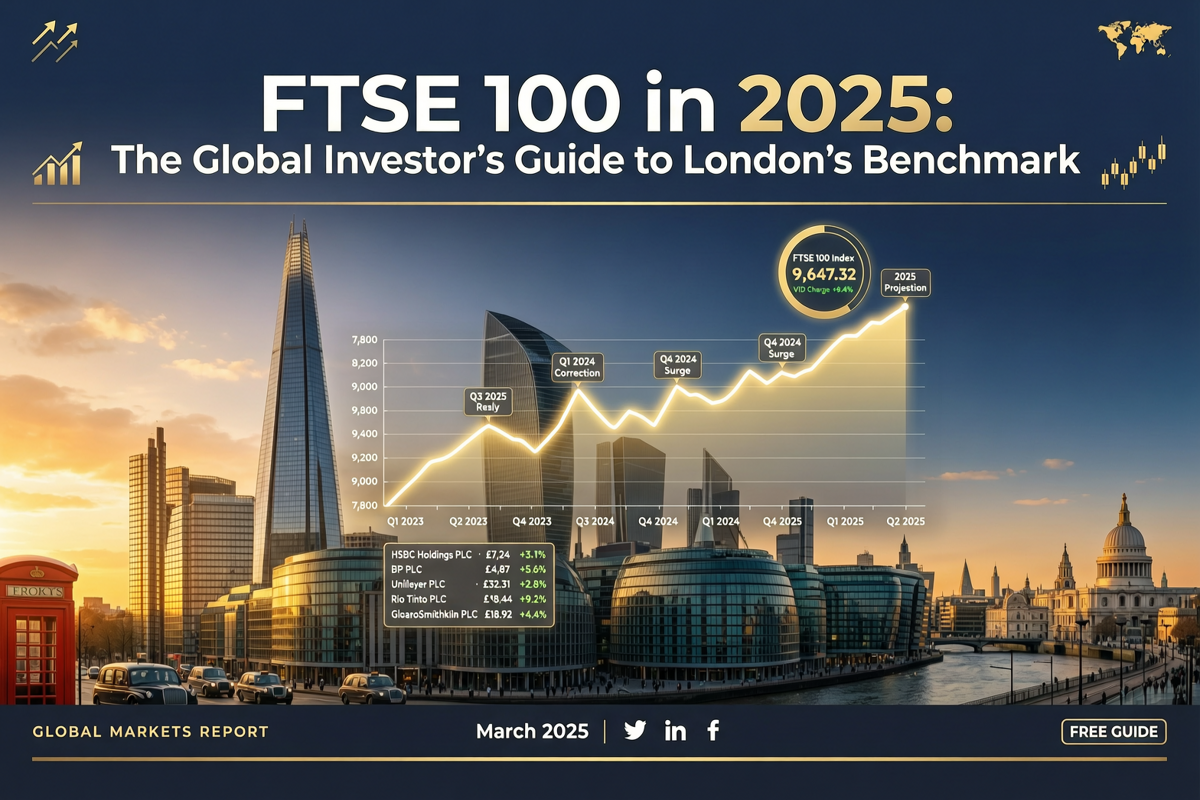
FTSE 100 in 2025: The Global Investor's Guide to London's Benchmark
Discover what's driving the FTSE 100 in 2025 - from heavyweight stocks and global trends to hidden opportunities for savvy investors.
What Exactly Is the FTSE 100?
The FTSE 100, often called the "Footsie," is the United Kingdom's most closely watched stock market index. Operated by FTSE Russell, it tracks the 100 largest companies listed on the London Stock Exchange, ranked by market capitalisation. Launched in January 1984, it has become a global barometer for British economic health and investor sentiment. While it is a UK index, the companies within it are truly international. Many earn the majority of their revenue abroad, making the Footsie a surprisingly global play.
For decades, the FTSE 100 has been a core holding for UK pension funds and individual investors. It represents roughly 80% of the total market value of all companies listed on the London Stock Exchange. Understanding its composition and the forces that move it is essential for anyone looking to invest in British shares or compare the UK economy with other major markets.
The FTSE 100's 2025 Landscape
Heading into 2025, the FTSE 100 presents a fascinating picture. After a volatile few years marked by inflation, rising interest rates, and geopolitical shocks, the index has shown remarkable resilience. It has repeatedly traded near record highs, yet many analysts argue it remains undervalued compared to its US counterparts. This perceived disconnect is one of the most talked-about stories in global finance.
Several forces are shaping the Footsie in 2025. The Bank of England has begun to ease monetary policy cautiously, with interest rate cuts slowly feeding through to consumer spending and corporate borrowing. Inflation, while cooler than in peak 2023, still lingers above target, keeping pressure on costs. Geopolitical risks—from the ongoing war in Ukraine to tensions in the Middle East—continue to affect energy prices and supply chains, impacting the index's heavy weighting in oil and mining giants.
At the same time, a weaker pound has proven to be a tailwind. Because most FTSE 100 constituents earn in dollars, a depressed sterling inflates their earnings when translated back into GBP. This currency effect is a subtle but powerful lever that many global investors watch closely.
Heavyweight Stocks That Move the Index
To understand the FTSE 100, you need to know its biggest players. The index is heavily concentrated in a few sectors: energy, materials, financials, consumer goods, and healthcare. Companies like Shell and BP dominate the energy sector, while mining titans such as Glencore, Rio Tinto, and Anglo American account for a large share of the materials component. These natural-resource stocks give the FTSE a distinctive cyclical profile.
Financials are equally influential, with HSBC, Lloyds Banking Group, Barclays, and NatWest forming a substantial portion. HSBC alone, as an internationally focused bank, often moves the index significantly. Consumer staples like Unilever and Diageo bring stability and defensive qualities, while AstraZeneca stands as a healthcare behemoth, one of the largest and most valuable companies in the index.
This concentration means that a handful of stocks can dictate the whole market's direction. When commodity prices rise, the FTSE often rallies; when banks struggle, the index falls. For investors, that is a double-edged sword—it can generate strong returns during cyclical booms, but also leads to volatility when the global economy slows.
Why Income Hunters Love the FTSE
One of the most attractive features of the FTSE 100 is its dividend culture. The index consistently offers a higher average dividend yield than the US S&P 500 or Japan's Nikkei 225. For income-focused investors, this makes London's benchmark a go-to destination. In 2025, dividends and share buybacks from Footsie companies are expected to remain robust, supported by solid cash flows in energy and mining.
Several blue-chip companies have a long track record of shareholder returns. So-called "dividend aristocrats" like National Grid, a utility, and Unilever, a consumer giant, are often celebrated for their resilient payouts. The FTSE's breadth of high-yielding stocks has made it a cornerstone of UK retirement portfolios, often accessed through tax-efficient wrappers such as SIPPs and ISAs.
However, chasing yield comes with risks. A high dividend yield can sometimes be a red flag, signalling a company whose share price has been falling. Investors must look beyond the headline yield to assess how well a dividend is covered by earnings and cash flow. The FTSE's sector composition also means that dividends can be volatile when commodity prices collapse.
How to Invest in the FTSE 100
For UK and international investors alike, there are several ways to gain exposure to the FTSE 100. The most straightforward is through index funds and exchange-traded funds (ETFs) that track the index. Popular choices include iShares Core FTSE 100 UCITS ETF, Vanguard FTSE 100 Index Fund, and HSBC FTSE 100 Index Fund. These low-cost funds allow you to buy a slice of all 100 companies in one go, providing instant diversification.
Another route is to purchase shares in individual FTSE 100 companies through a share dealing account, ISA, or SIPP. This provides more control, allowing you to tilt your portfolio toward sectors or companies you favour, but it also requires more research and carries single-stock risk. Investment trusts, such as Scottish Mortgage or F&C Investment Trust, often hold FTSE 100 stocks alongside international positions, offering a managed approach.
When investing in the FTSE 100, consider whether you need a fund that accumulates dividends or one that pays them out. Reinvesting dividends is a powerful way to grow wealth over the long term. Also, be mindful of currency exposure. If you live outside the UK, fluctuations in the pound will affect your returns.
Risks to Watch in 2025
No investment comes without risk, and the FTSE 100 has its fair share of concerns. Perhaps the most prominent is concentration risk. The index's heavy tilt toward financials, energy, and materials means that a downturn in any of these sectors will disproportionately hurt performance. This concentration is slightly masked by the index's broad count, but the top ten companies account for around 40% of the entire index.
Another risk is the UK economy itself. Although many constituents earn internationally, a prolonged period of low domestic growth or political uncertainty could weigh on investor sentiment and retail activity. The UK's large and persistent trade deficits also expose the pound to volatility, which can work both for and against domestic investors.
Geopolitical shocks are a perennial risk. Any escalation of conflicts in Eastern Europe, the Middle East, or Asia could disrupt energy supplies and commodities, causing sudden swings in the Footsie. Meanwhile, regulatory changes, including potential windfall taxes on oil and gas profits, could impact shareholder returns.
The FTSE 100 vs. Global Peers
How does the FTSE 100 stack up against other global benchmarks? Compared to the US S&P 500, the Footsie looks inexpensive on a price-to-earnings basis. That gap reflects structural differences in sector composition, with the S&P 500 dominated by high-growth technology companies, while the FTSE 100 is full of more traditional, cash-generative businesses. For some, this makes the FTSE a value play; for others, it simply explains why it lags during tech-led rallies.
When compared to the Nikkei 225, another developed-market index, the FTSE has a similar profile of established exporters with solid dividends. But Japan's recent corporate governance reforms have attracted global attention, potentially making Tokyo a more dynamic market. In Europe, the German DAX has a stronger industrial and technology presence, but it also faces energy and export challenges.
Ultimately, the FTSE 100 offers diversification away from the tech-centric US market. By including UK equities in a global portfolio, investors can reduce their exposure to one region or style and tap into a different mix of cash flows and shareholder returns.
Outlook and Final Thoughts
Looking ahead for the rest of 2025, the FTSE 100 appears poised for a continuation of its slow but steady climb, provided the global economy avoids a severe downturn. Interest rate cuts, easing inflation, and resilient corporate earnings could all act as catalysts. Meanwhile, the intrinsic lure of high dividends remains strong, especially for retirees and institutional investors seeking income.
That said, the index's future is not predetermined. The potential for commodity price shocks, political upheaval, or a sharp global slowdown cannot be ignored. Smart investors will keep an eye on the Bank of England's policy path, the strength of the US economy, and the fortunes of the heavyweight sectors.
The FTSE 100 is more than just a number. It is a reflection of British enterprise, global commodity cycles, and the enduring appeal of dividend-paying blue chips. Whether you're a seasoned investor or just starting out, understanding the Footsie's nuances is a valuable step toward building a resilient and diversified investment strategy. And with the right approach, the UK's leading index can still offer a dependable path to long-term wealth.