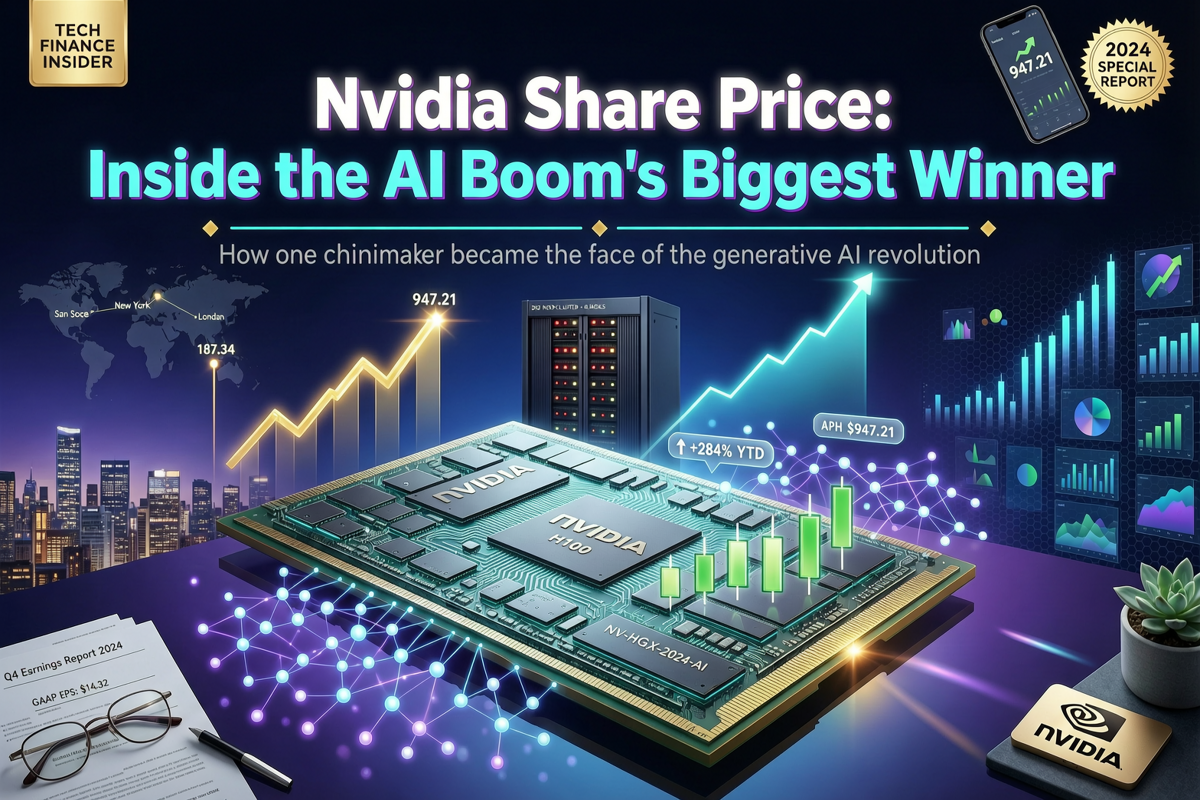
Nvidia Share Price: Inside the AI Boom's Biggest Winner
Why is Nvidia's share price soaring while skeptics call it a bubble? Dive into the earnings engine, valuation risk, and the AI capex cycle shaping NVDA in 2025.
The AI Demand Curve That Rewrote Nvidia's Story
For years, Nvidia was known primarily as a gaming graphics card company. But a seismic shift in computing powered by generative AI has transformed the company into the undisputed engine of the artificial intelligence revolution. The result: Nvidia's share price has delivered staggering returns, turning the stock into a focal point for institutional investors, retail traders, and tech strategists alike.
At its core, Nvidia's rally is not a speculative meme. It is backed by an unprecedented surge in demand for GPUs, the chips that now train and run the world's most advanced AI models. From OpenAI to Google, from Microsoft to a cascade of startups, everyone appears to need Nvidia's Hopper and Blackwell architecture processors. This is why the company's data center segment, which barely existed a decade ago, now accounts for the overwhelming majority of its revenue.
Financials That Justify the Hype
Investors chasing Nvidia's share price are not betting on fiction. The company's earnings reports have repeatedly shattered expectations, with revenue growing at triple-digit rates quarter over quarter in the most recent cycles. Gross margins hover near 70%, a jaw-dropping figure for a hardware maker, and free cash flow continues to expand dramatically. This financial supercycle gives the stock a fundamental anchor that most high-flying tech names can only dream of.
Nvidia's market capitalization has, at times, surpassed $2 trillion, placing it among the most valuable companies in history. The rally is driven by a virtuous loop: AI companies buy Nvidia chips, build data centers, and raise more capital to buy even more chips. For now, the trajectory remains upward, but investors must ask a critical question: How much of this is already reflected in the current price?
The Valuation Dilemma: Priced for Perfection
No conversation about Nvidia's share price is complete without examining valuation. By most traditional metrics, the stock trades at a rich premium. Its forward price-to-earnings ratio hovers in the 30s or higher, depending on the market cycle. While that is not nosebleed territory compared to the dot-com bubble's excesses, it leaves little room for hiccups. If Nvidia posts a single disappointing quarter, the stock could see a violent correction.
This is the central tension of the NVDA narrative. The company's executed balance sheet is superb, but the valuation assumes that AI spending will remain at supercharged levels for years. Any sign that capital expenditure growth is slowing at major cloud providers, or that Chinese clients face tighter export controls, could send shockwaves through the share price. Wall Street remains split between those who view Nvidia as a generational growth story and those who call it a bubble waiting to burst.
What Drives Nvidia's Share Price in 2025?
Looking ahead, several factors will influence how Nvidia's stock performs in 2025. The launch of new Blackwell-based products is a major catalyst, as enterprise customers rush to upgrade their AI infrastructure. Meanwhile, the company is expanding its software and networking offerings, creating a moat that goes beyond raw silicon.
- Data center momentum: The core business shows no signs of slowing, as hyperscalers and sovereign AI initiatives drive orders.
- Product cycles: Each new architecture delivers a performance leap, forcing out refreshes that sustain recurring revenue.
- Supply constraints: Tight capacity, especially in advanced packaging, has allowed Nvidia to command premium prices and allocate inventory strategically.
- Software ecosystem: Nvidia's CUDA platform remains the default choice for AI developers, locking in long-term customer loyalty.
These drivers explain why analysts keep raising their price targets. Yet even bullish forecasts depend on the assumption that AI adoption reaches every industry, from healthcare to robotics. If that transformation proceeds, Nvidia's share price could still have a long runway. If it stumbles, the correction will be fierce.
The Risks That Could Derail the Rally
For every tailwind, there is a headwind. One of the biggest looming risks is competition. AMD has intensified its challenge with the MI300X accelerator, and a swarm of cloud providers, including Amazon and Google, are developing their own custom ASICs. These alternatives may not match Nvidia's raw performance, but they are cheaper and increasingly effective for specific workloads.
Regulatory and geopolitical factors are equally substantial. The United States has imposed export controls that restrict Nvidia from selling its most advanced chips to China, a historically significant market. Meanwhile, governments around the world are scrutinizing the concentration of AI power in one company, which could lead to antitrust actions or forced changes in business practices.
The macro environment also matters. Interest rates affect the valuation multiples that investors are willing to pay for high-growth tech stocks. A prolonged period of high rates, or a recession that forces CIOs to slash budgets, would directly impact Nvidia's order backlog. The same economic conditions that fueled the AI hype cycle could just as easily deflate it.
Bottom Line: Opportunities and Pitfalls
Nvidia's share price is a reflection of the most powerful trend in technology right now: artificial intelligence. The company has executed with near-perfection, turning silicon into gold and setting records that seem absurd by historical standards. For investors, the key is separating the company's brilliance from the stock's price. Great company, high price — that is a delicate equation.
Long-term believers might still find NVDA attractive, especially if they plan to hold through volatility. Short-term traders, however, must be prepared for wild swings, as any earnings miss or geopolitical headline can trigger a selloff. The smartest approach is to recognize both the tremendous upside and the inherent risks. Nvidia is not just a stock; it is a barometer for the AI era itself, and its share price will continue to make headlines for years to come.