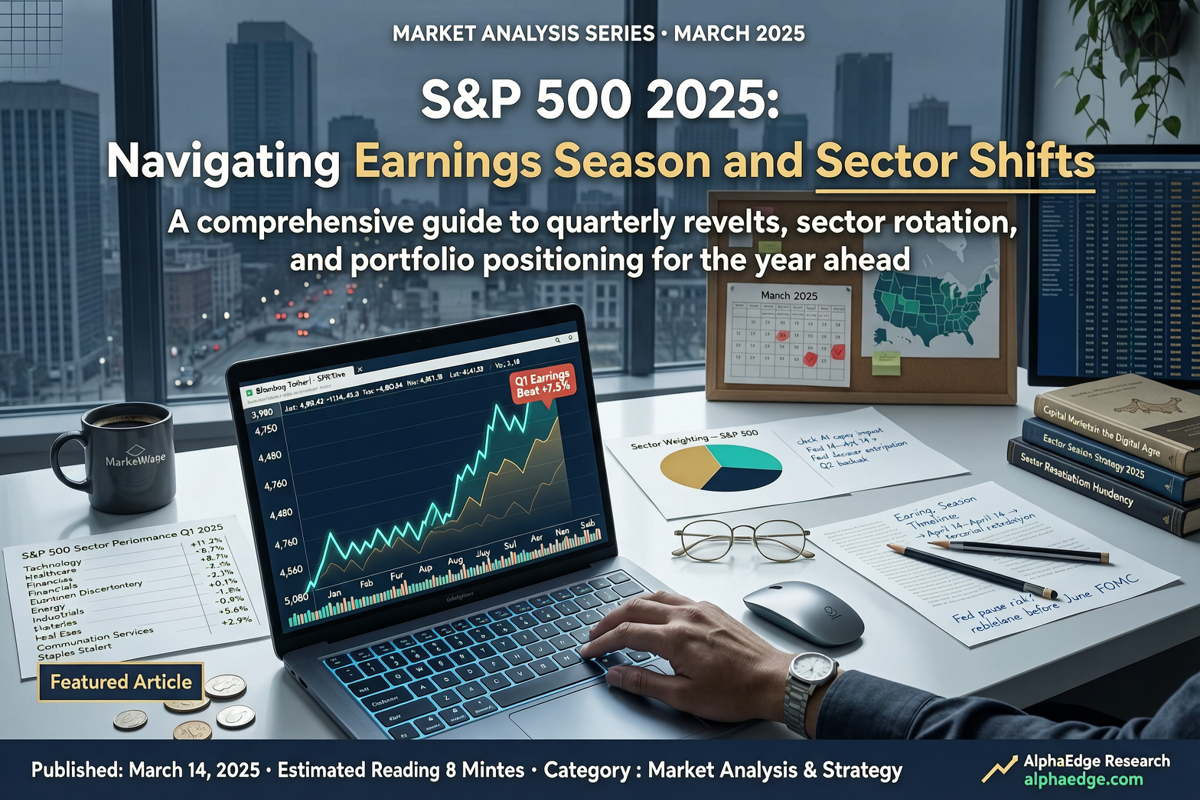
S&P 500 2025: Navigating Earnings Season and Sector Shifts
Explore the S&P 500's 2025 outlook, focusing on earnings growth, sector rotation, and key market drivers. Insights for investors navigating a dynamic landscape.
Introduction
The S&P 500 index remains the benchmark for U.S. equities, and 2025 is shaping up to be a pivotal year. With earnings season underway and sector rotation accelerating, investors face both opportunities and challenges. This article delves into the key factors influencing the index, from corporate profits to monetary policy, and offers actionable insights for those looking to navigate the evolving market landscape.
Earnings Growth: The Cornerstone of Market Performance
Earnings reports are the lifeblood of stock valuations. In 2025, analysts expect a moderate but steady earnings growth of around 8-10% for S&P 500 companies, driven by strong consumer spending and technological innovation. However, this growth is uneven across sectors. The technology sector, which dominates the index, continues to post robust results, buoyed by artificial intelligence and cloud computing. Meanwhile, energy and materials sectors face headwinds from fluctuating commodity prices and slowing global demand.
Key Earnings Drivers
- Artificial Intelligence Monetization: Major tech firms are turning AI investments into tangible revenue streams, boosting earnings in digital advertising, software, and semiconductors.
- Consumer Resilience: Despite high interest rates, consumer discretionary earnings have held up, thanks to a strong labor market and rising wages.
- Cost Discipline: Many companies have optimized operations post-pandemic, leading to improved profit margins even in a sluggish growth environment.
Sector Rotation: Where the Money Is Moving
Sector rotation is a hallmark of changing market cycles. In early 2025, we are seeing a shift from growth stocks to value and cyclical sectors. Historically, this rotation signals that investors expect economic expansion to broaden beyond tech. Financials, industrials, and healthcare are attracting capital as earnings in these sectors catch up with valuations.
Notable Rotation Patterns
- Technology to Financials: As interest rates stabilize, banks and insurance companies benefit from higher net interest margins and improved loan demand.
- Energy to Utilities: With oil prices moderating, utilities offer stable dividends and defensive appeal amid geopolitical uncertainty.
- Small Caps Outpacing Large Caps: The Russell 2000 has outperformed the S&P 500, indicating investor confidence in domestic economic recovery.
Key Risks to the S&P 500 Outlook
No forecast is without risk. Three major uncertainties cloud the 2025 outlook: inflation persistence, geopolitical tensions, and valuation concerns. Inflation remains above the Federal Reserve's target, keeping the door open for further rate hikes. A prolonged conflict in the Middle East or trade disruptions could spike energy prices. Additionally, the S&P 500's price-to-earnings ratio is above historical averages, leaving it vulnerable to earnings disappointments.
Investment Implications for 2025
Given the earnings growth and sector rotation trends, investors should consider a balanced approach. Diversification across sectors is crucial to mitigate risk. Focus on companies with strong cash flows and pricing power. In the tech space, look beyond mega-caps to mid-cap innovators. For income, consider dividend-paying stocks in sectors like healthcare and utilities. Active management may outperform passive indexing in this rotational environment.
Conclusion
The S&P 500 in 2025 offers a mixed but potentially rewarding environment. Earnings growth provides a solid foundation, but sector rotation and external risks require vigilance. By understanding the key drivers—earnings quality, rotation signals, and macro risks—investors can position themselves to capitalize on opportunities while protecting against downsides. As always, staying informed and adaptable is the best strategy.