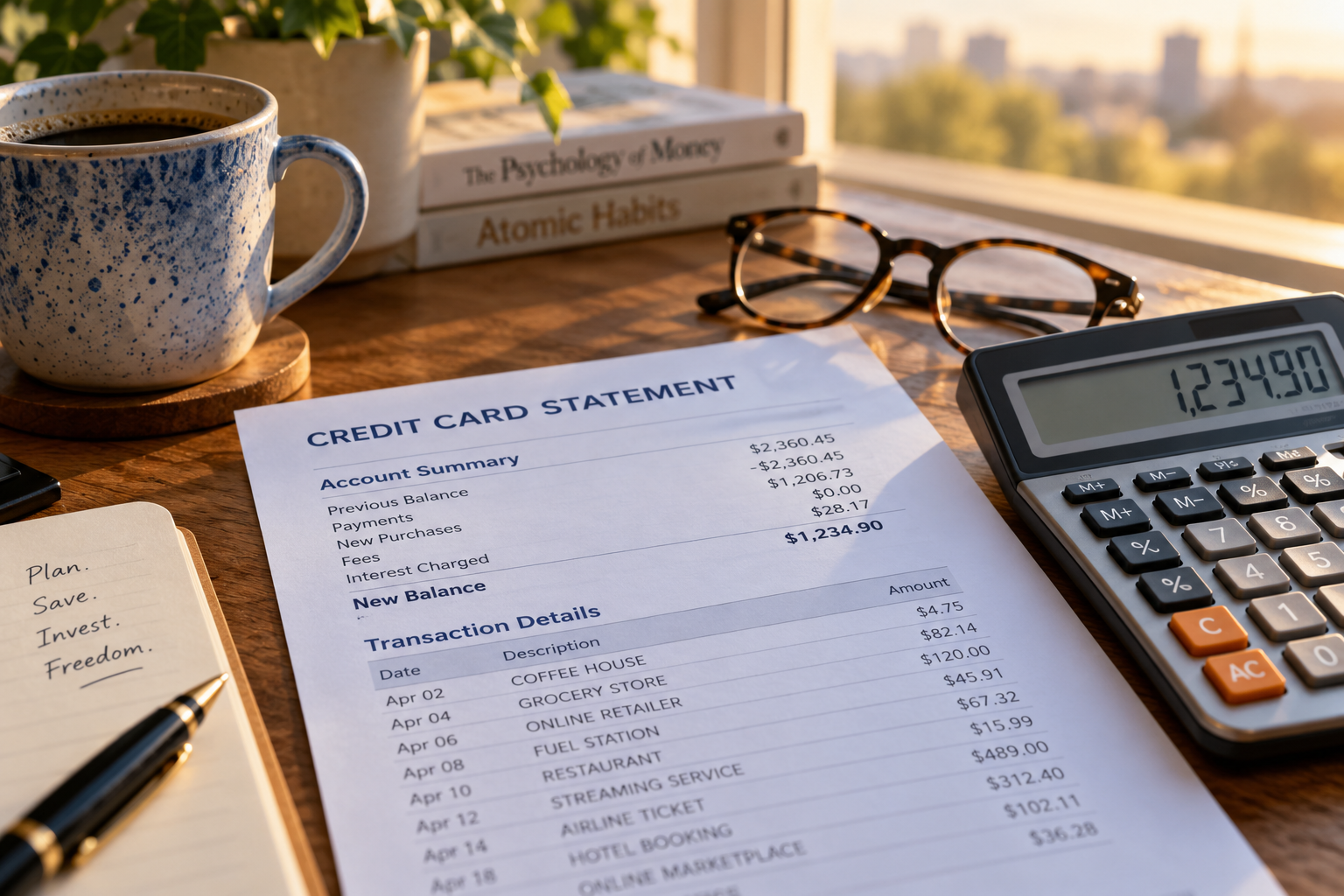
Credit Card Interest: How APR Quietly Doubles Your Balance
Your credit card's APR is not a single number you pay once a year. Here is how daily interest, minimum payments and average balances quietly grow what you owe.
Most people can recite their credit card's APR. Far fewer can explain what that number does to their balance between statements. The gap matters, because a credit card is one of the few consumer products where doing nothing — paying the minimum, skipping a month, letting a balance ride — can cost more than the original purchase.
This is a plain-language guide to how card interest actually works, why minimum payments so often fail to shrink a balance, and which levers genuinely move the needle.
What the APR on your statement really means
APR stands for annual percentage rate, but card issuers do not wait twelve months to charge you. They convert the APR into a daily periodic rate by dividing it by 365. At 24.99% APR, that is roughly 0.0685% per day. Every day a balance sits unpaid, that fraction is applied to it.
Purchase APR, balance transfer APR, and cash advance APR are usually different numbers, and cash advances typically carry no grace period at all — interest starts the day the money leaves the ATM. Always check which rate applies to which transaction before assuming your headline APR is the one in play.
The minimum payment trap
Typical minimum payments are calculated as a small percentage of the balance — often 1% to 3% — plus that month's interest, with a floor of around $25 to $35. That structure is designed for the issuer's convenience, not your payoff speed.
Consider a $5,000 balance at 24.99% APR. Monthly interest is about $104. If your minimum is 2% of the balance, that is $100 — less than the interest charge. Pay the minimum and the balance grows. Even when the minimum does clear interest, the principal shrinks at a crawl, and as the balance falls the required payment falls with it.
Now take a smaller $3,000 balance at 22% APR. Pay $150 a month and you clear it in roughly 25 months, handing over about $760 in interest — a quarter of the original debt in pure financing cost. Drop that payment to the issuer's minimum and repayment can stretch past a decade.
How the interest charge is calculated
Most issuers use the average daily balance method. Here is the sequence behind that line on your statement:
- Your balance is recorded each day of the billing cycle.
- Those daily balances are averaged across the cycle.
- The average is multiplied by the daily periodic rate, then by the number of days in the cycle.
Two practical consequences follow. First, a mid-cycle payment lowers your average balance and therefore your charge — timing is not irrelevant. Second, new purchases made after a payment can still accrue interest from their transaction date in some cases, which is why a balance that never quite hits zero keeps generating charges.
Where the grace period fits
If you paid the previous statement in full and on time, most cards give you a grace period on new purchases — interest-free days between the statement closing and the due date. The catch is the trailing balance rule: carry even a small amount past the due date and you can lose the grace period on new spending until you return to a zero balance. That is why a card you thought was nearly paid off can suddenly generate interest on fresh purchases.
Three levers that cut interest fastest
1. Pay above the minimum, deliberately
Adding even $50 to a minimum payment attacks principal directly. On revolving debt, the fastest wins come from the highest-APR balance first, because that is where each dollar of repayment saves the most.
2. Ask for a rate review
Issuers rarely volunteer a lower APR, but a short call citing on-time payment history and competing offers sometimes works. A two- or three-point reduction is not dramatic, yet on a $6,000 balance it is real money over a year.
3. Use 0% offers carefully
A balance transfer to a 0% promotional card can pause interest for 12 to 21 months. Read the fee — typically 3% to 5% of the transferred amount — and the go-to APR that applies to any remaining balance when the promo ends. Miss one payment and some issuers revoke the promotional rate immediately.
Why interest and your credit file interact
Carrying a balance does not automatically hurt your credit score, but high credit utilization does. Balances above roughly 30% of your limit are commonly treated as a risk signal, and balances near the limit are treated more harshly still. Paying down principal therefore does double duty: it reduces interest expense and improves the ratio lenders look at.
Payment history remains the single heaviest factor. A missed due date can trigger a late fee, a penalty APR near 29.99%, and a derogatory mark that lingers for years.
The bottom line
A credit card is cheap if you clear the statement each month and expensive if you do not. Interest is charged daily, minimum payments are calibrated to prolong balances, and promotional rates come with expiry dates. Know your daily periodic rate, pay more than the minimum on your priciest balance, and treat a zero balance as the default state rather than an occasional achievement.