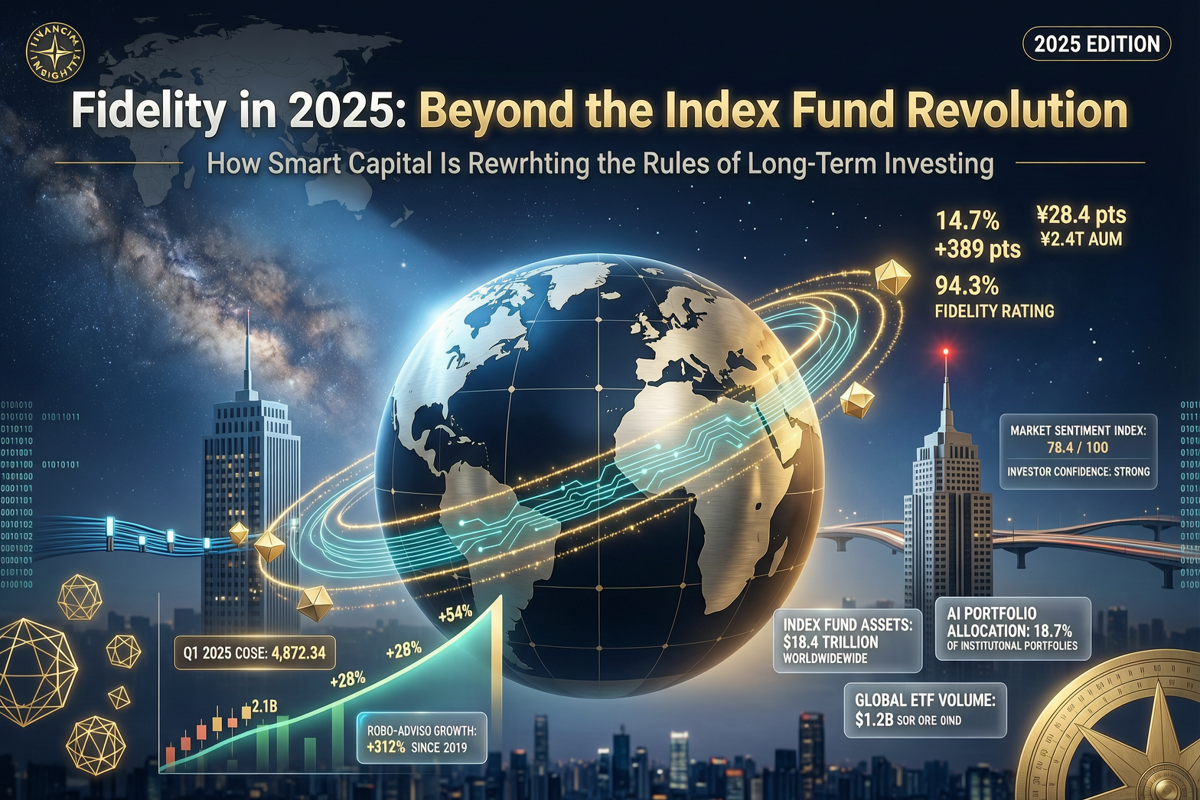
Fidelity in 2025: Beyond the Index Fund Revolution
Explore how Fidelity is reshaping investing in 2025 with new tools, crypto integration, and personalized advice beyond passive index funds.
Fidelity’s Next Chapter
For decades, Fidelity Investments has been synonymous with index fund investing and retirement planning. But as 2025 unfolds, the Boston-based giant is quietly transforming into something more: a technology-driven, multi-asset financial ecosystem. While competitors scramble to copy its low-cost model, Fidelity is already moving beyond the index fund revolution that it helped popularize.
The Crypto Pivot
One of the most significant shifts is Fidelity’s embrace of digital assets. After years of cautious exploration, the firm now offers bitcoin and ether trading directly within its brokerage accounts. In 2025, Fidelity also launched a tokenized money market fund, allowing investors to earn yield on stablecoins held in their portfolios. This move bridges the gap between traditional finance and decentralized finance, a strategy few major brokerages have dared to pursue.
Personalized Advice at Scale
Fidelity’s robo-advisor, Fidelity Go, now integrates with human advisors through a hybrid model. Clients can start with automated portfolios and seamlessly escalate to a certified planner for complex needs like tax-loss harvesting or estate planning. The firm’s AI-powered tool, “Fidelity Insights,” analyzes spending patterns and suggests portfolio adjustments in real time, making personalized advice accessible to investors of all sizes.
Active Management Reimagined
While passive investing remains popular, Fidelity is betting on a new breed of active funds. Its “Contrafund” and “Magellan” have been revamped with quantitative overlays, blending human judgment with machine learning. These funds now adapt to market regimes faster than traditional active managers, aiming to capture upside while limiting drawdowns. Early performance data suggests this hybrid approach is winning back investors who fled to passive strategies after 2020.
The Retirement Revolution
Fidelity’s 401(k) platform is also evolving. In 2025, it introduced “Lifetime Income” options that automatically convert a portion of savings into guaranteed annuities at retirement age. This addresses the longevity risk that many retirees face, without requiring them to purchase expensive standalone products. The firm has also integrated student loan repayment matching into its employer plans, a feature that resonates with younger workers.
Zero-Commission Trading Evolves
Fidelity was a latecomer to zero-commission trading, but it has turned the model into a differentiator. Instead of selling order flow like some rivals, Fidelity routes trades to maximize price improvement. In 2025, it launched “Fidelity Direct,” a digital banking account that pays interest on cash balances and offers free ATM access worldwide. This creates a sticky ecosystem where users can invest, bank, and borrow in one place.
ESG and Impact Investing
Environmental, social, and governance (ESG) investing has faced political backlash, but Fidelity has doubled down. Its “Sustainable Family” of funds uses proprietary data to score companies on climate risk, labor practices, and board diversity. In 2025, the firm also launched a green bond ETF that invests in municipal projects for renewable energy and water infrastructure. These products appeal to a growing cohort of investors who want their portfolios to reflect their values.
Global Expansion
Fidelity is no longer just a US-centric firm. Its international arm, Fidelity International, now manages over $500 billion in assets across Europe, Asia, and the Middle East. In 2025, it opened a fully digital brokerage in Singapore and partnered with Indian fintechs to offer mutual funds to retail investors. This global reach diversifies Fidelity’s revenue and exposes it to faster-growing markets.
Cybersecurity and Trust
With great scale comes great responsibility. Fidelity has invested heavily in biometric authentication and behavioral analytics to detect fraud. Its “Security Guarantee” promises to cover any losses from unauthorized account activity, a pledge that builds trust in an era of rising cyber threats. The firm also offers free credit monitoring and identity theft insurance to all account holders.
Challenges Ahead
Despite these innovations, Fidelity faces headwinds. The rise of commission-free trading apps like Robinhood has eroded its dominance among young investors. Meanwhile, regulatory scrutiny of crypto could slow its digital asset ambitions. And the shift to passive investing, while profitable for Fidelity’s index funds, has compressed margins across the industry.
The Bottom Line
Fidelity in 2025 is not your father’s mutual fund company. It is a technology firm that happens to manage money, a bank that trades stocks, and a retirement planner that understands crypto. By blending the best of active and passive, digital and human, traditional and decentralized, Fidelity is positioning itself for the next 50 years. For investors, the message is clear: the index fund revolution was just the beginning.