Minesweeper: The Tiny Logic Game That Still Hooks Millions
Minesweeper looks like luck, but it's pure deduction. Here's how the numbers work, why experts still lose, and how to win more boards without guessing.
Minesweeper is the rare game that has been installed on more computers than it has ever been searched for. It shipped with Windows for roughly two decades, taught a generation what a right-click actually does, and then quietly slid into browsers and phone apps where it still pulls in a stubbornly devoted crowd. It looks like a game of luck — you click a square, you might explode — but almost every board is a solvable logic problem dressed up as a gamble.
What Minesweeper actually is
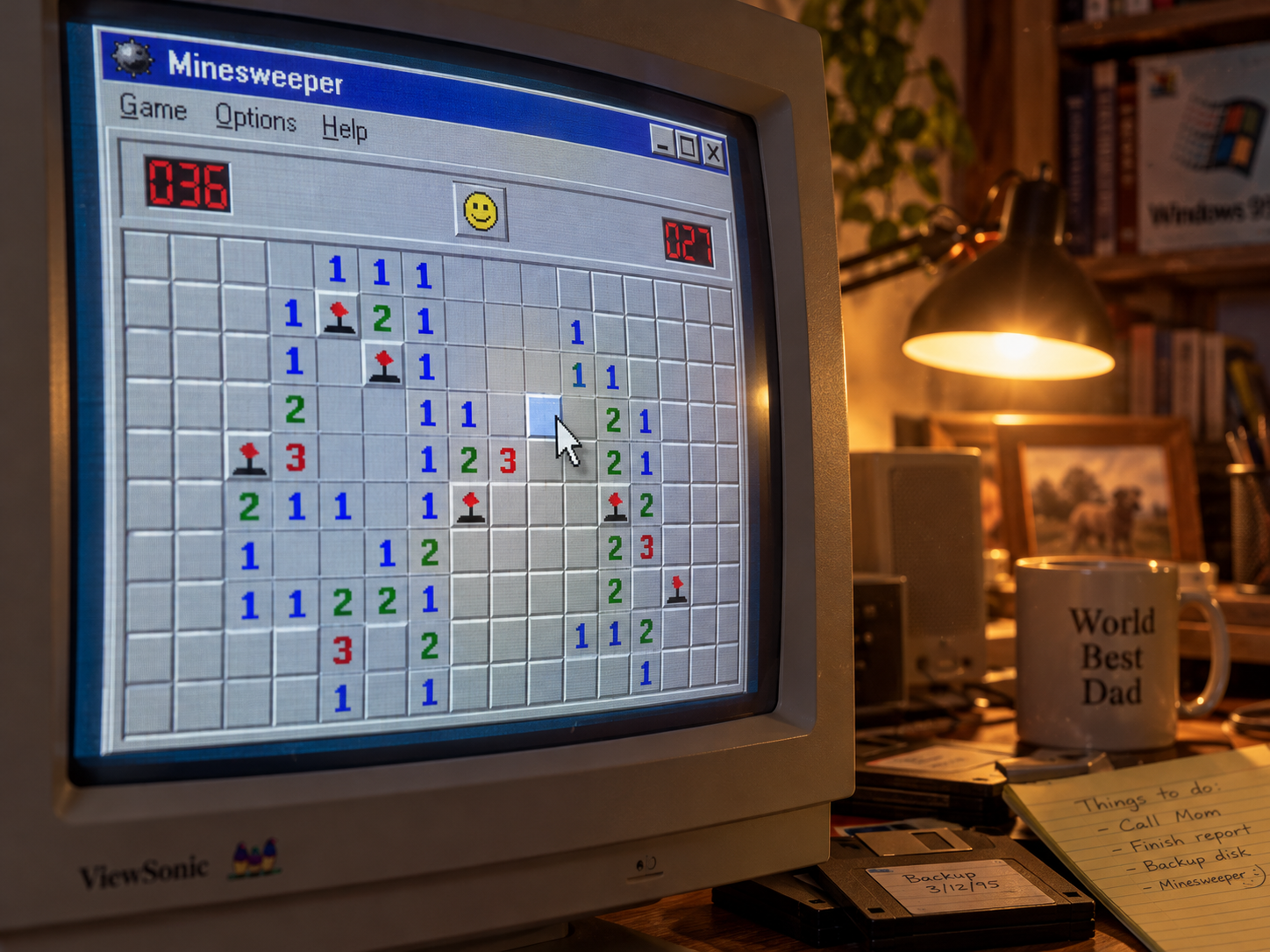
The board is a grid of covered squares. A hidden number of them — usually 10 on the beginner 9×9 board, 40 on intermediate, 99 on expert — conceal mines. Click a safe square and it flips open, showing a digit from 1 to 8: the count of mines in the eight squares around it. Click a mine and the round ends. Clear every safe square and you win, often in under a minute, and then you immediately play again.
The right-click flag is not decoration. It marks a square you have deduced is a mine, which frees your attention and, in most modern versions, unlocks a useful shortcut. The original game was reportedly built partly as a way to teach new computer users to click and right-click with confidence, which explains why the controls feel like muscle memory even to people who have not opened it in years.
The numbers are constraints, not hints
New players read the digits as probabilities. Strong players read them as statements of fact, the same way a sudoku solver reads a cell. Every revealed number constrains its neighbours exactly, and those constraints combine into something close to arithmetic.
The three moves that solve most boards
- Counting. A "1" touching exactly one covered square owns a mine. A "1" that already has its one mine flagged owns no others, so every other covered neighbour is safe.
- Subtraction. When a square sits between two numbers, compare them. A "2" and a "1" sharing the same neighbours differ by exactly one square — and that square must be the mine.
- Patterns. On a flat wall, 1-2-1 puts mines on the two outer tiles, while 1-2-2-1 puts them on the two inner ones. Learn four or five of these shapes and the middle of the board stops being frightening.
Then there is chording: on a number whose mines are all flagged, clicking both mouse buttons at once opens every remaining neighbour. Chording is where experienced players make up their time, because it does several clicks of work in one motion.
The honest truth about guessing
Not every loss is your fault, and knowing that is oddly freeing. Randomly generated boards sometimes contain genuinely ambiguous positions — the famous fifty-fifty, where two squares look identical and nothing on the board can distinguish them.
Two things follow. First, when you feel stuck, re-scan the whole board before you gamble; somewhere else there is usually a fully determined move you have simply not noticed. Second, when no deduction exists, guess deliberately: pick the square that, if safe, opens the most information. Watch the fastest expert clears, now comfortably under a minute, and you will see they are not lucky — they spend almost every click on a move that resolves more of the board.
Measuring a board instead of a stopwatch
Speed records get the headlines, but the more interesting idea in the community is 3BV, a count of the minimum number of clicks a board requires assuming perfect play and no guessing. It converts a fuzzy "that felt hard" into a number, letting two players compare time per unit of 3BV and see who actually played better rather than who got a friendlier board.
Why a 1990s time-killer still works
The appeal is almost the opposite of modern game design. There is no tutorial, no story, no shop, and no streak you can lose for a week. A round lasts as long as a coffee break, and the feedback is immediate and honest: you were right, or you were wrong, and the board tells you which.
That honesty is the hook. Minesweeper rewards a specific mental habit — holding several small facts in mind and checking whether they contradict each other — that carries over into debugging code, reading a spreadsheet, or working out why a schedule does not add up. It is also one of the few casual puzzle games where improvement is unmistakable. A hundred boards from now, positions that looked like static will look like sentences.
Five habits that will clear more boards
- Start in a corner or edge. Opening against a wall gives you numbers with fewer neighbours, which are easier to read.
- Flag late, not eagerly. Flags are bookkeeping; if you flag on instinct, you will build deductions on top of a guess.
- Clear the easy perimeter first. The outside ring of a board resolves fastest and often unlocks the interior for free.
- Chord constantly once numbers are satisfied. It is the single biggest speed gain available.
- Do not chase a lost board. Restarting costs two seconds; a bad guess costs the round anyway.
Minesweeper endures because it asks almost nothing of you and then quietly asks everything: patience, attention, and the willingness to stop guessing and start reading. The minefield was never random. It was just waiting for you to do the arithmetic.