Unblocked Games: Why Browser Puzzles Slip Past Filters
Unblocked games thrive on school and office networks. Here's how browser puzzle portals work, why filters miss them, and the real risks worth weighing.
Search for "unblocked games" and you get a sprawling, near-identical crowd of portals promising free browser games that will load on a school Chromebook or a locked-down office laptop. The phrase has become a genre label, a search keyword, and a small act of digital rebellion all at once. But what does it actually mean for a game to be "unblocked" — and why do puzzle titles dominate the category? The answers say a lot about how network filtering works, and where it quietly fails.
What "unblocked" really means
Network filters block in a few blunt ways: by domain, by IP address, by content category, or by keyword in the URL. An "unblocked" game is not technically different from any other game. It is simply hosted somewhere the filter has not yet catalogued, or served through an intermediary that fetches the content on the visitor's behalf. The game itself is ordinary HTML and JavaScript; the trick is entirely in distribution.
That is why the category is so unstable. Blocklists are reactive. A domain gets flagged, and within days a dozen near-identical mirrors appear on fresh addresses, often with random strings in the name. The result is a permanent, low-grade arms race between network administrators and whoever is fastest at registering a new domain.
The mechanics: proxies, mirrors, and HTML5
Most workarounds rely on three techniques. Web proxies load a page through a third-party server, so the browser never talks to the blocked site directly. Mirror domains host or embed the same game at dozens of different addresses. Iframe embedding pulls game files from a content delivery network and drops them inside a page that looks like a normal site.
All of this became dramatically easier after December 2020, when Adobe retired Flash. The plugin era had been awkward for filters because games lived inside .swf files; the HTML5 and WebGL era that replaced it runs natively in any modern browser, with no install and no plugin prompt. A game can now load in under a second on a five-year-old laptop. Convenience for players and convenience for the people running these portals turned out to be the same thing.
Why puzzle games dominate
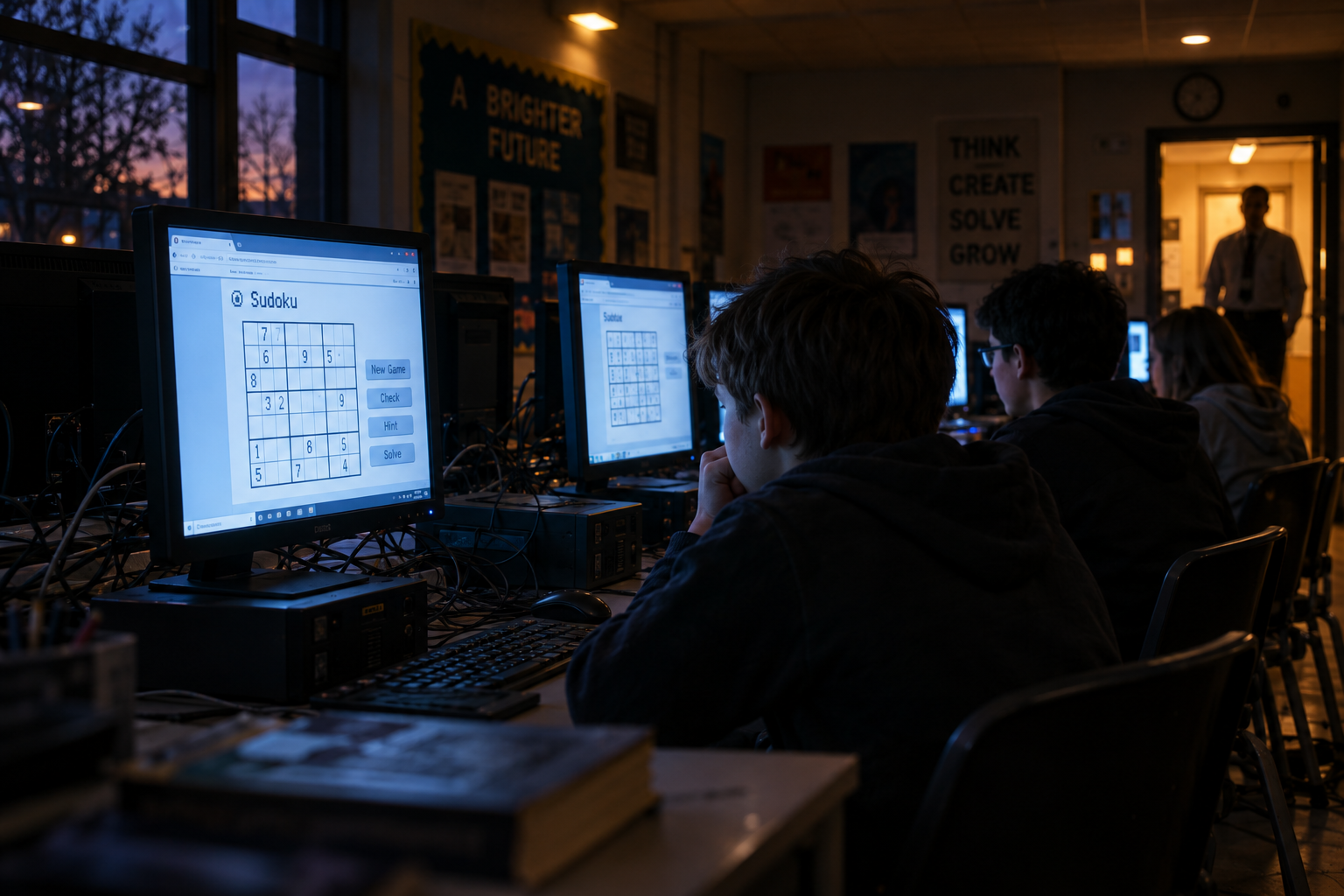
Look at what actually gets played on these sites and you will find a heavy bias toward puzzles, casual arcade, and idle games. The reasons are practical:
- Small file sizes. A 2048 clone or a sudoku grid loads instantly on weak school hardware.
- No accounts. Nothing to sign up for, nothing to verify, no email required.
- Short sessions. A round can last two minutes or twenty, which suits a passing period or a coffee break.
- Quiet inputs. Keyboard and mouse only, no microphone, no camera, no chat.
- The "one more try" loop. Word games, merge puzzles, mahjong, and match-three titles are engineered to be restarted instantly.
Puzzles also carry a useful fig leaf. A student playing a crossword or a nonogram can plausibly claim to be doing something educational, which is part of why these titles survive scrutiny longer than a first-person shooter would.
The risks nobody puts on the homepage
The uncomfortable truth is that low-quality game portals are a well-known delivery channel for junk. Common problems include aggressive malvertising, giant fake "Download" or "Play Now" buttons that lead somewhere else, redirect chains that bounce through several ad networks, and pop-ups impersonating a Google or Microsoft login screen to harvest credentials.
There is also the quieter stuff: no privacy policy, heavy third-party tracking, cookies set by a dozen unidentified vendors, and occasionally scripts that quietly borrow a visitor's processor to mine cryptocurrency. Because these sites are frequently unmoderated and anonymously operated, there is no one to complain to when something breaks or misbehaves.
Finally, there is the rulebook question. On school and corporate networks, using a proxy to bypass filtering typically violates an acceptable-use policy regardless of what the game is. The technical workaround and the disciplinary risk are separate problems, and only one of them is solvable with software.
A short, messy history
Browser gaming has respectable ancestors: Newgrounds and Miniclip in the early 2000s, Kongregate with its achievement systems, and teacher-built portals like Coolmath Games that curated puzzles deliberately. When Flash died, much of that catalogue vanished or was rebuilt in HTML5, and a new generation of aggregators moved in to fill the gap. Some are legitimate businesses with real ad standards and content policies. Many are scraped shells that exist mainly to serve impressions. The word "unblocked" does not distinguish between the two — a polished portal and a malware-adjacent clone can look identical from the search results page.
What schools, parents, and IT teams can actually do
Blocklists will always lag. A more durable approach is layered: use DNS or category filtering that updates frequently, whitelist a small set of vetted game portals for sanctioned break time, and treat the rest as a teaching moment rather than a pure enforcement problem.
For parents, the useful conversation is about clicking. Most of the real harm on these sites comes from a single tap on a fake download button, not from the game. Keep browsers and operating systems patched, run an ad blocker on managed devices, and explain why a pop-up asking for a password is never legitimate. Pupils who understand the trick tend to stop being impressed by it.
The bottom line
Unblocked games are less a genre than a symptom: proof that blocklists alone are a weak way to govern attention. The puzzles themselves are often harmless — genuinely good five-minute distractions that load on anything with a browser. The surrounding ecosystem is where the risk lives. Treat the portals as untrusted advertising surfaces, keep the technical basics tight, and the difference between a pleasant diversion and a nasty surprise comes down to a single click.